
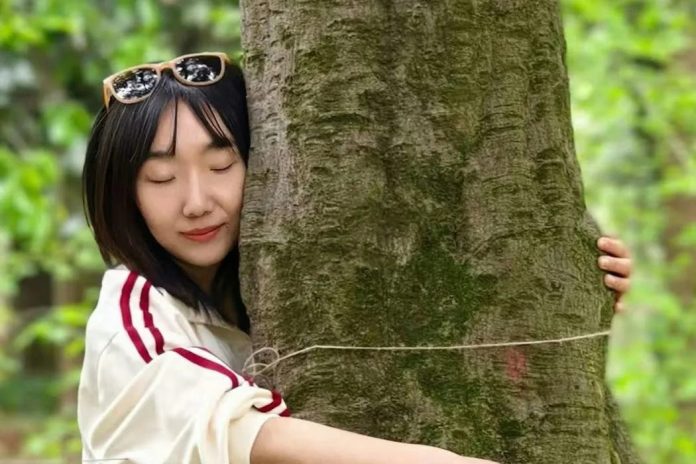
Why so many young people in China are hugging trees
In Beijing’s central district, trees are everywhere. In parks, along roadsides and in courtyards inside people’s houses. Many have only been planted in recent decades.
Others – with wide trunks – have been around for centuries and are cosy to touch: you can form an arm chain around them with a friend, trace your fingers along the bark or rest your ear on the trunk to listen to the inner workings of the tree. To hug a tree is an art. This ability does not come intuitively. It must be learned.
“Hugging trees is a way of having touch in one’s life,” Xiaoyang Wong, the leader of a forest therapy community in Beijing, told me. Wong is a 35-year-old former film editor who recently retrained as a forest therapist after the COVID pandemic left her feeling alone and isolated.
At first, many people feel awkward about hugging a tree, she told me. But in forest therapies, Wong encourages people to understand the tree’s many worlds by observing it at close quarters, watching the ants and other insects as they weave in and out of the grain of the bark.
Only after being curious about it and speaking with it, she encourages people to decide to touch or even hug it. I was a natural at tree hugging, she told me. I, however, had only learned how to hug a tree from watching other people do this supposedly silly practice in parks across the city.
In Beijing, most of the ancient trees are fenced in by the local government to protect them from damage; however, the newer ones are still available for people to touch and gather around.
Seeking relief
On weekends and even late at night, I discovered people – young and old, mothers and daughters, friends and lovers – hugging trees or resting their backs against a trunk while seeking relief from everyday stresses.
These stresses have compounded, especially after the COVID pandemic when loneliness and isolation became commonplace. Moreover, as many young women in China contest the idea of marriage, they seek friendships and new ways of pursuing a good life.
Trees, scholars argue, make young people feel “rooted” and “alive”. In my interviews with more than 25 young women and men as part of my ongoing research – which is yet to be published – I discovered that more women than men went to forest therapy, seeking both friendship with trees and other human beings.
In these therapies, Wong adapted the traditional forest bathing therapies with her own ideas to enhance people’s engagement. These include “plant enactment” where people could take on the name of their favourite tree, and be called by this name all day. She encouraged us, the participants in the therapy, to share a gesture that we associated with our chosen plant, one that described how we imagined the tree would move.
Wong was joined in these sessions by other women who too had given up the pursuit of high-pressure jobs, and had instead taken this part-time work to look after people, trees and plants in the city.
In one of these group sessions, a tree hugger, Florian Mo, expressed his frustration at not being able to find and sustain love in his life. He argued that a key problem with Chinese society was the stigmatisation of the pursuit of love at a young age.