
The World of Health & Medicine News

NAIL DETACHMENT MORE COMMON WITH GLP-1 USE

NAIL DETACHMENT MORE COMMON WITH GLP-1 USE

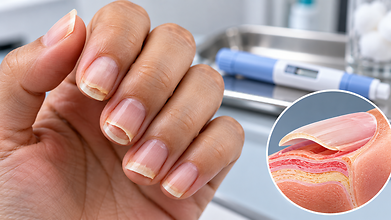
Nail detachment was more common among patients using GLP-1 drugs for weight loss or diabetes than non-users in a study presented on Thursday at the European Academy of Dermatology and Venereology Congress, opens new tab in Vienna.

Dr. Charles Taïeb of Necker University Hospital in Paris and colleagues surveyed 575 first-time GLP-1 drug users and 1,329 people who had never taken the drugs. All of them ​had diabetes or obesity, or both.

Overall, 39% of the GLP-1 users reported nail detachment in which the nail separates from the soft tissue underneath. That compared with 9% of non-users.

The increased risk with GLP-1 drugs persisted regardless of how much ​weight people lost during treatment, the researchers found.

A separate study involving the same participants found hair loss beginning after treatment initiation was more than twice as common among users (26% vs 12%), while loss of hair volume or density affected 42% of those taking ‌GLP-1 drugs compared ⁠with 19% of non-users.

Most patients with hair loss also had scalp symptoms such as itching, redness or scaling.

“This suggests that what is happening on the scalp may go beyond the classical shedding seen after rapid weight loss and involve an inflammatory component,” Dr. Bruno Halioua, a Paris dermatologist who led the hair loss study, said in a statement.

Halioua suggested clinicians should be looking for the condition “which may be treatable.”

Neither study proves GLP-1 treatment caused the changes.

But taken together, the findings suggest that factors beyond weight loss alone may contribute to the hair, scalp and nail changes observed among GLP-1 users, Halioua said.


spot_img

Explore more

spot_img

RADIATION EFFECTIVE AS SURGERY FOR LOCALIZED PROSTATE CANCER

RADIATION EFFECTIVE AS SURGERY FOR LOCALIZED PROSTATE CANCER Radiotherapy kept localized prostate cancer under control just as well as surgery, with fewer side effects, researchers...

US FDA approves Asahi Kasei’s drug for persistent herpes infections

US FDA approves Asahi Kasei's drug for persistent herpes infections The US FDA on Friday approved Japan's Asahi Kasei's (3407.T), opens new tab drug for...

Teva wins FDA approval for monthly schizophrenia injection Weltruza

Teva wins FDA approval for monthly schizophrenia injection Weltruza Teva (TEVA.TA), opens new tab ​said on Friday it had received approval ‌from the US Food...

Experimental approach uses AI to eliminate cold storage for mRNA vaccines

Experimental approach uses AI to eliminate cold storage for mRNA vaccines TEMPERATURE STORAGE OF MRNA VACCINES MAY BE NEAR Using artificial intelligence, researchers may have found...

WHO endorses lifestyle changes over GLP-1 drugs in child obesity fight

WHO endorses lifestyle changes over GLP-1 drugs in child obesity fight Children under 10 should avoid weight-loss drugs, surgery — health agency Adds obesity drugs should...

Easing constipation: A 20-minute walk can get your gut moving almost...

Easing constipation: A 20-minute walk can get your gut moving almost immediately Researchers found that just 20 minutes of comfortable walking can rapidly stimulate the...

This common vitamin could help fight one of the deadliest brain...

This common vitamin could help fight one of the deadliest brain cancers Vitamin B3 looks promising to help rearm a compromised immune system. High-dose vitamin B3...

German and US scientists win Nobel Prize in medicine

German and US scientists win Nobel Prize in medicine Karl Deisseroth, Peter Hegemann and Georg Nagel won the award for discoveries that provide new insights...