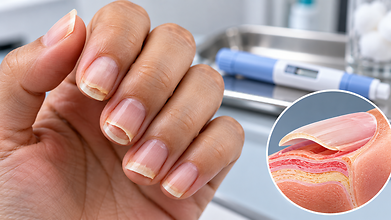
NAIL DETACHMENT MORE COMMON WITH GLP-1 USE
Nail detachment was more common among patients using GLP-1 drugs for weight loss or diabetes than non-users in a study presented on Thursday at the European Academy of Dermatology and Venereology Congress, opens new tab in Vienna.
Dr. Charles Taïeb of Necker University Hospital in Paris and colleagues surveyed 575 first-time GLP-1 drug users and 1,329 people who had never taken the drugs. All of them had diabetes or obesity, or both.
Overall, 39% of the GLP-1 users reported nail detachment in which the nail separates from the soft tissue underneath. That compared with 9% of non-users.
The increased risk with GLP-1 drugs persisted regardless of how much weight people lost during treatment, the researchers found.
A separate study involving the same participants found hair loss beginning after treatment initiation was more than twice as common among users (26% vs 12%), while loss of hair volume or density affected 42% of those taking GLP-1 drugs compared with 19% of non-users.
Most patients with hair loss also had scalp symptoms such as itching, redness or scaling.
“This suggests that what is happening on the scalp may go beyond the classical shedding seen after rapid weight loss and involve an inflammatory component,” Dr. Bruno Halioua, a Paris dermatologist who led the hair loss study, said in a statement.
Halioua suggested clinicians should be looking for the condition “which may be treatable.”
Neither study proves GLP-1 treatment caused the changes.
But taken together, the findings suggest that factors beyond weight loss alone may contribute to the hair, scalp and nail changes observed among GLP-1 users, Halioua said.